


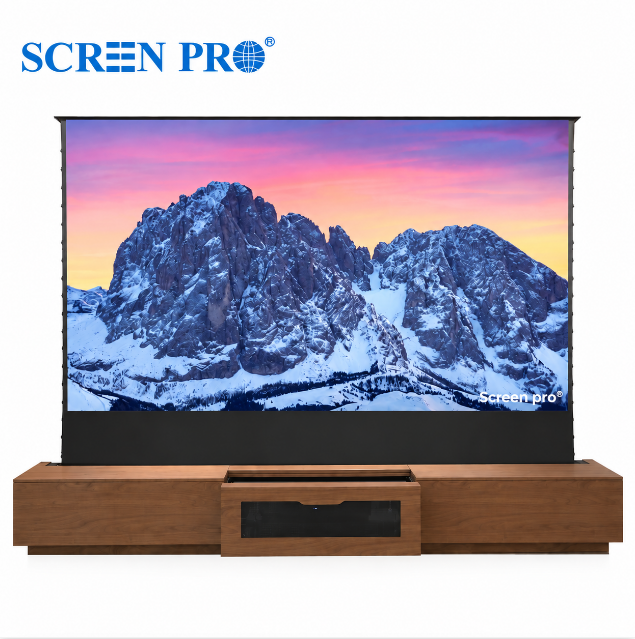
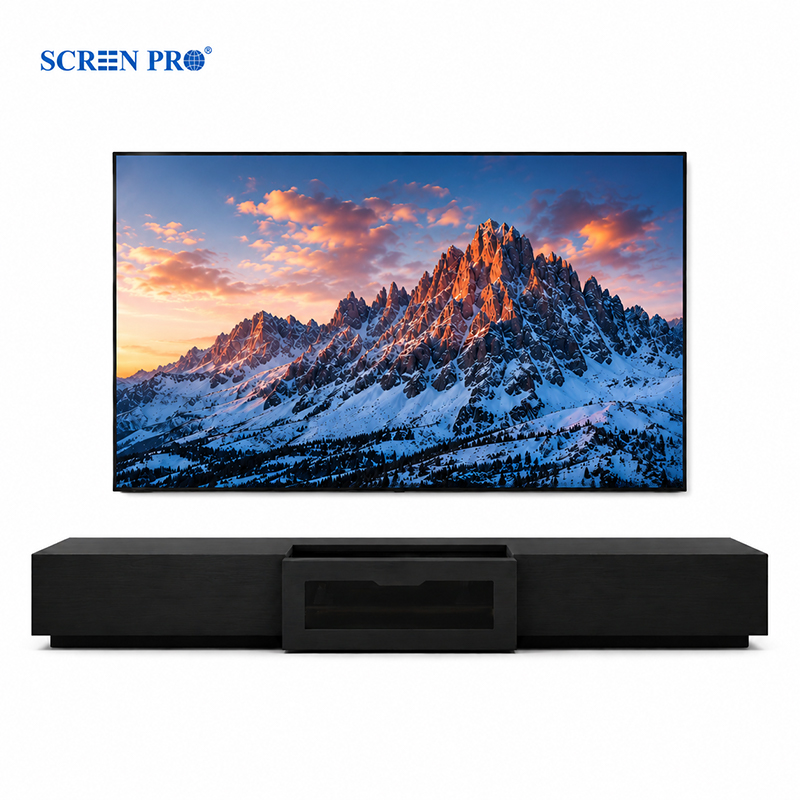
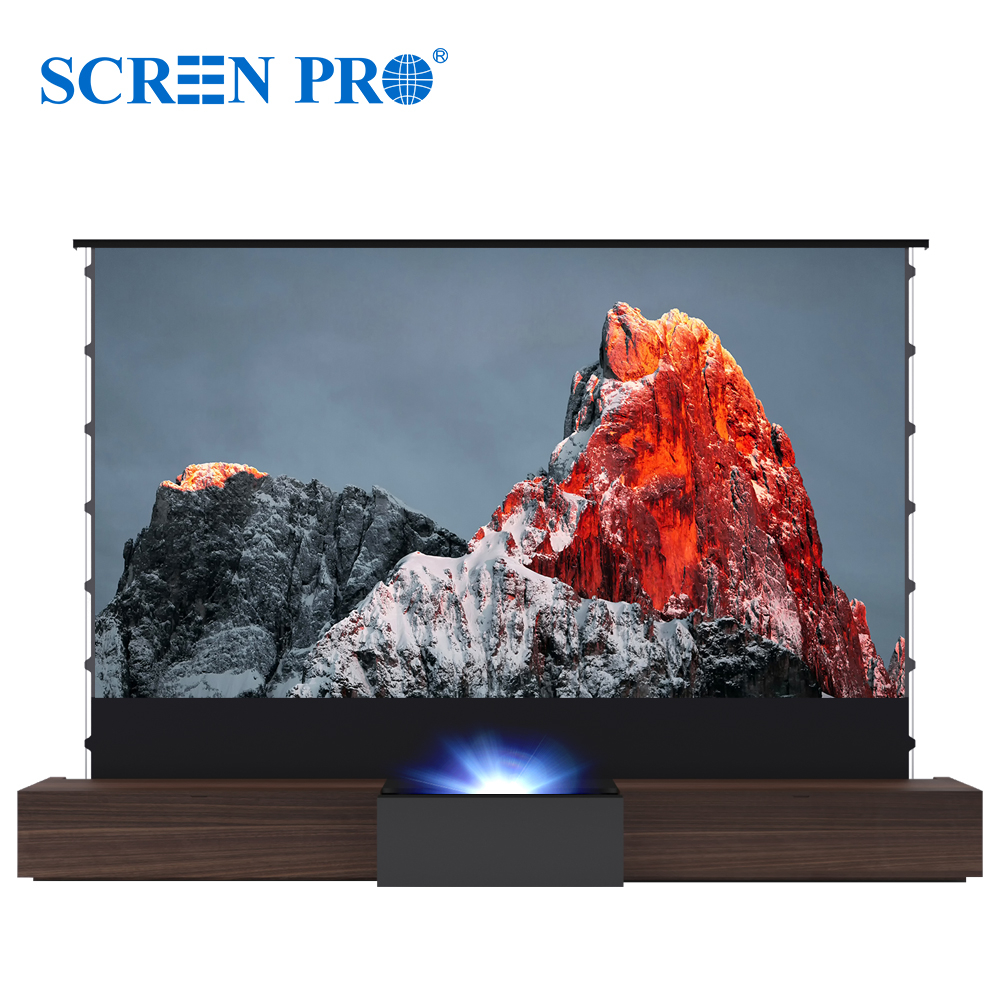
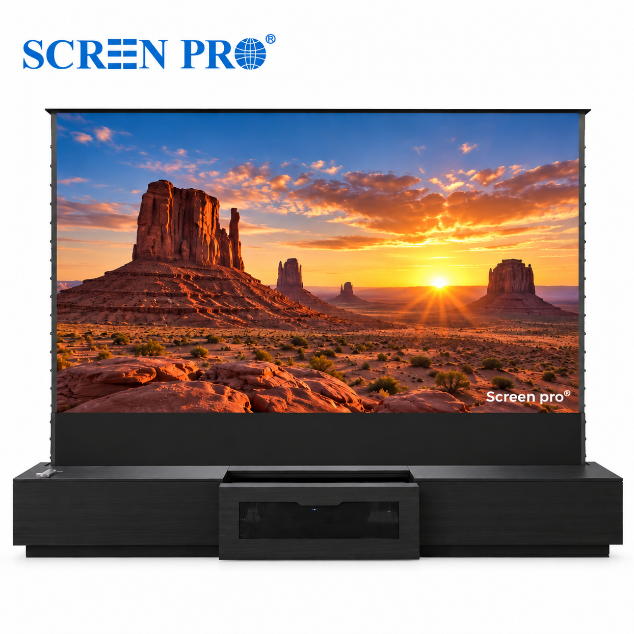
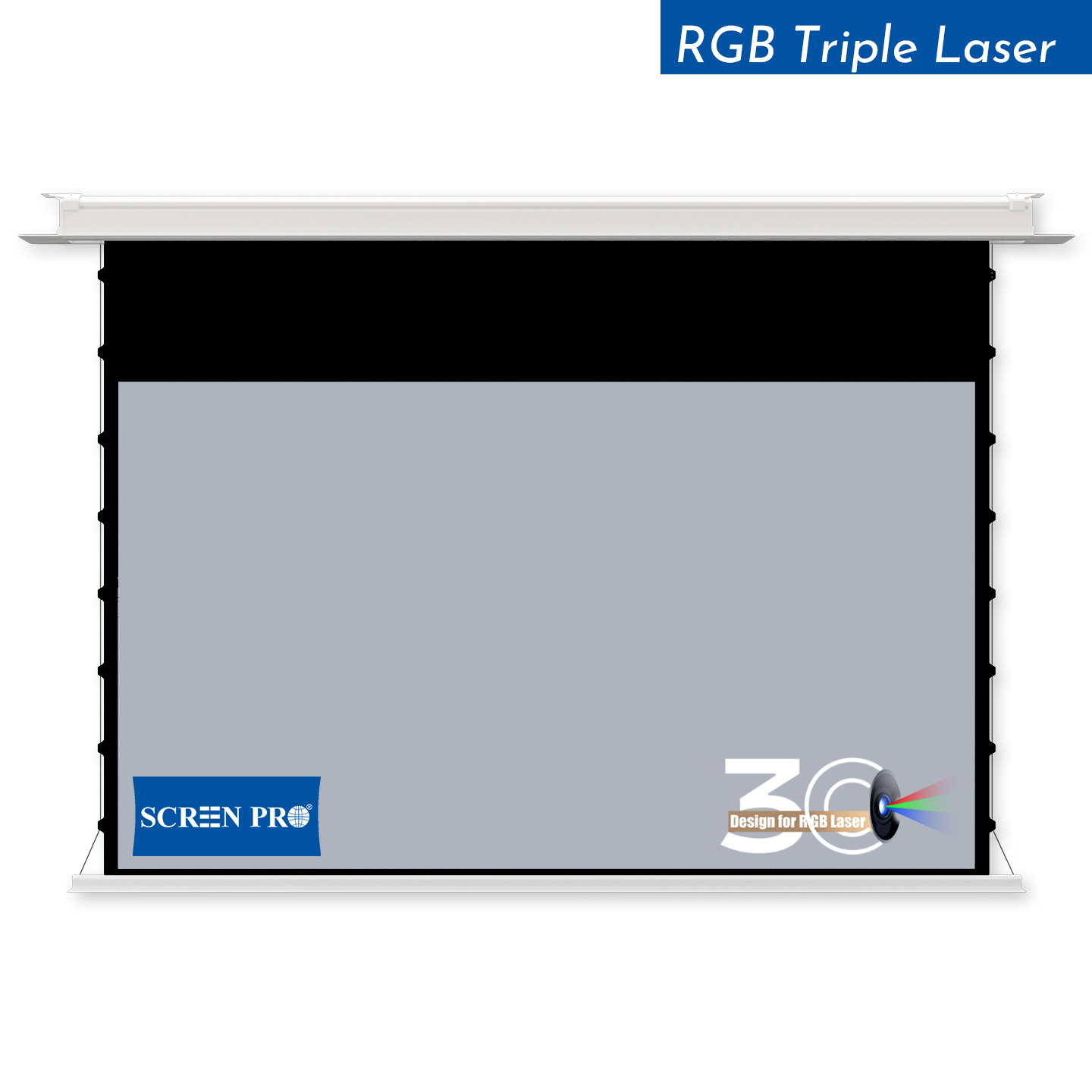
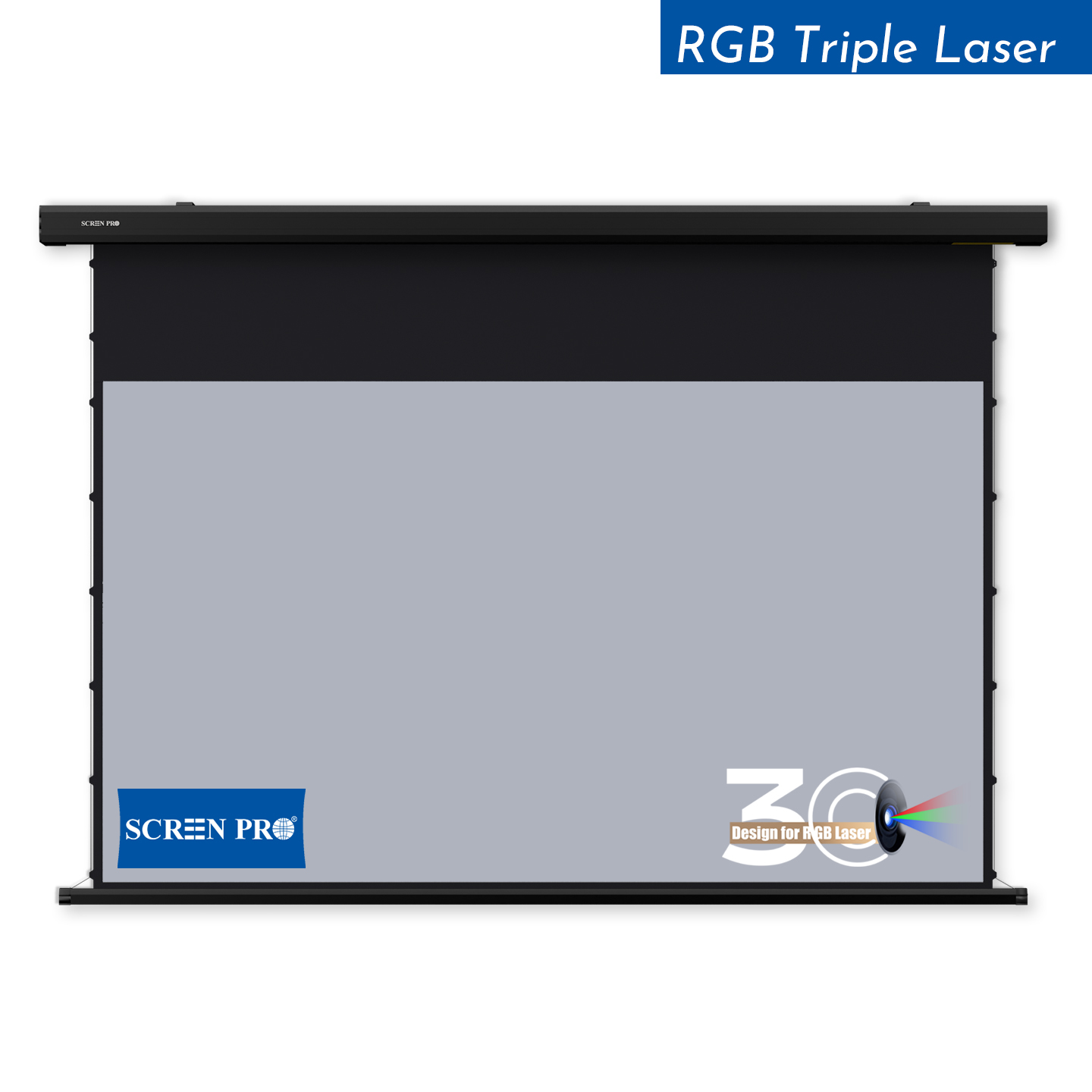
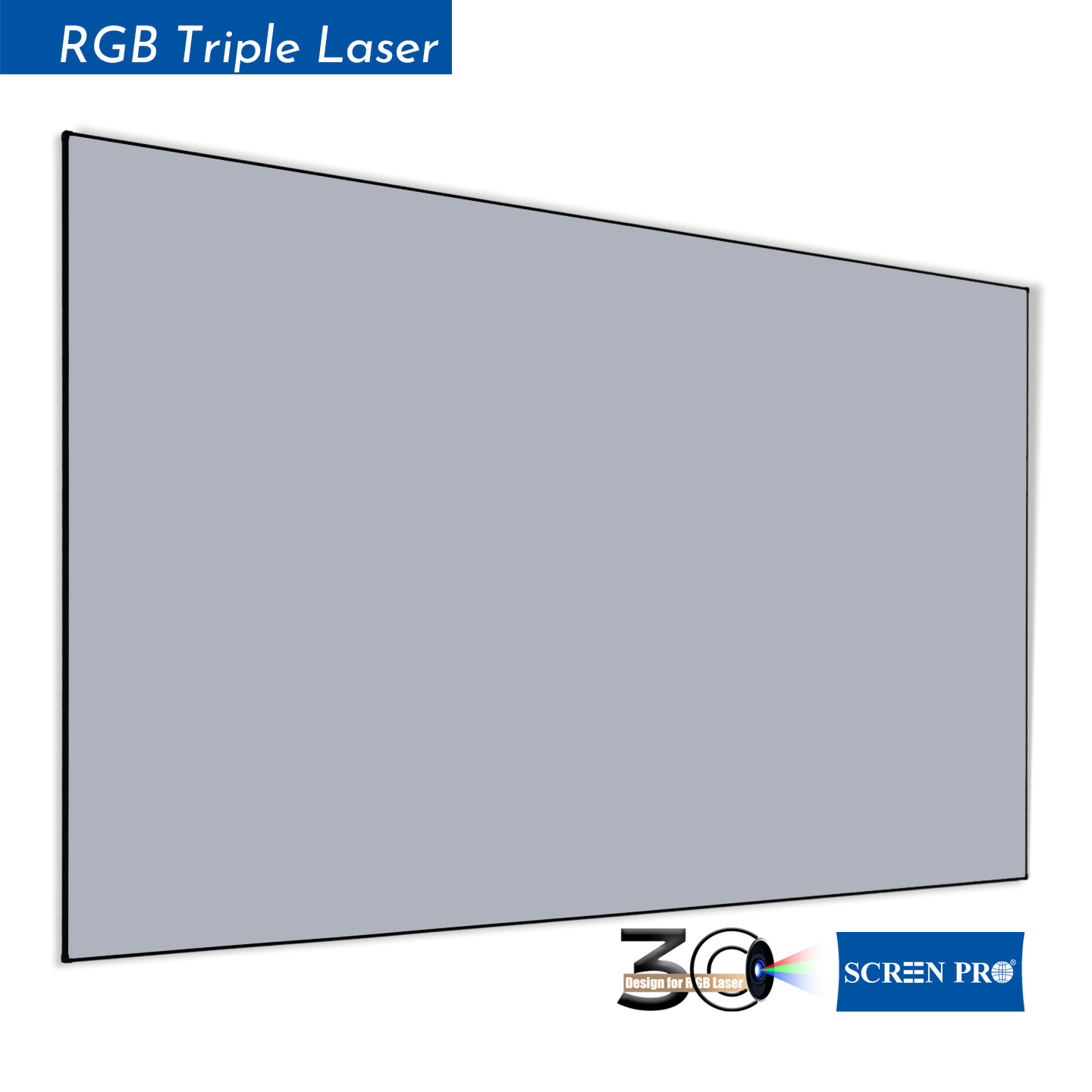
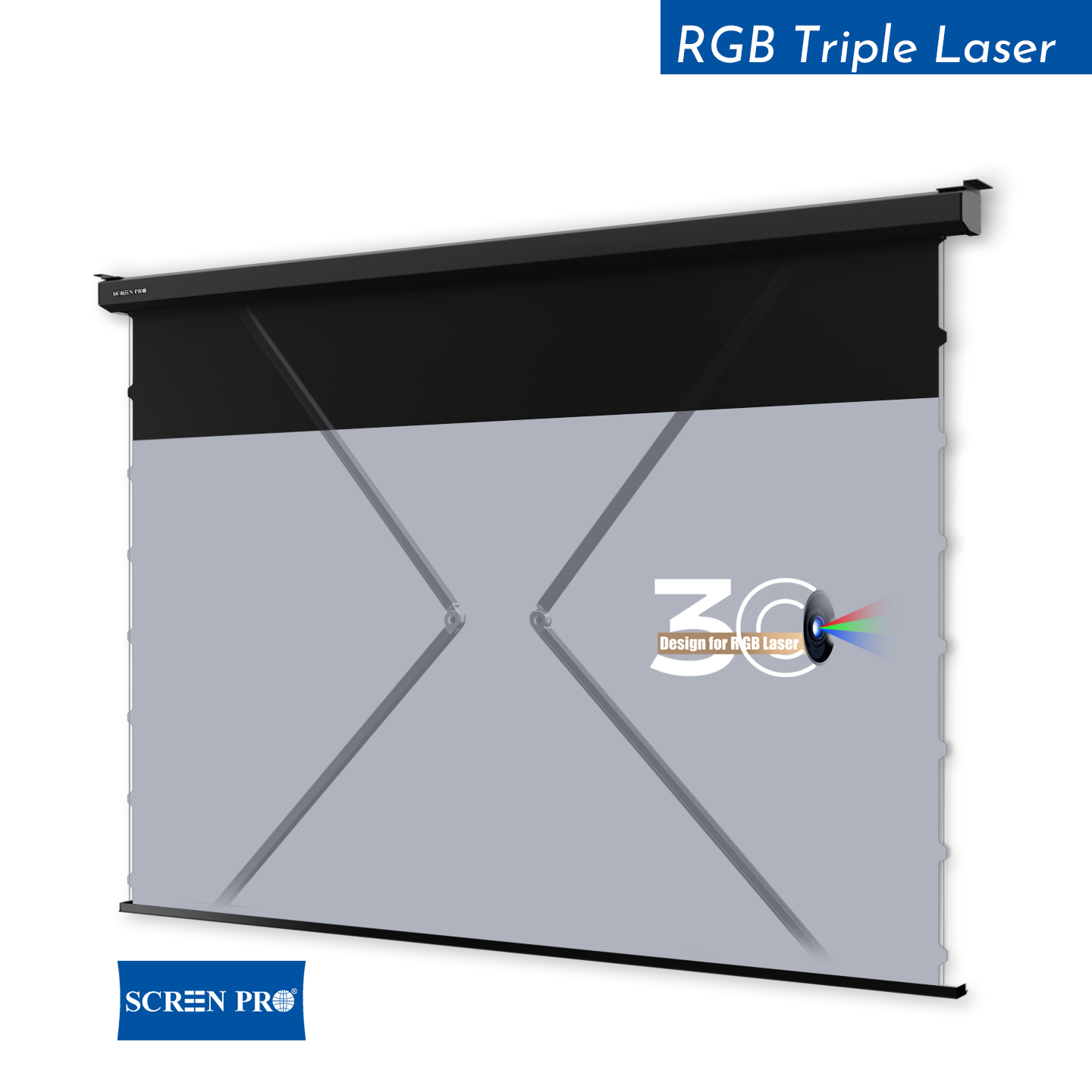

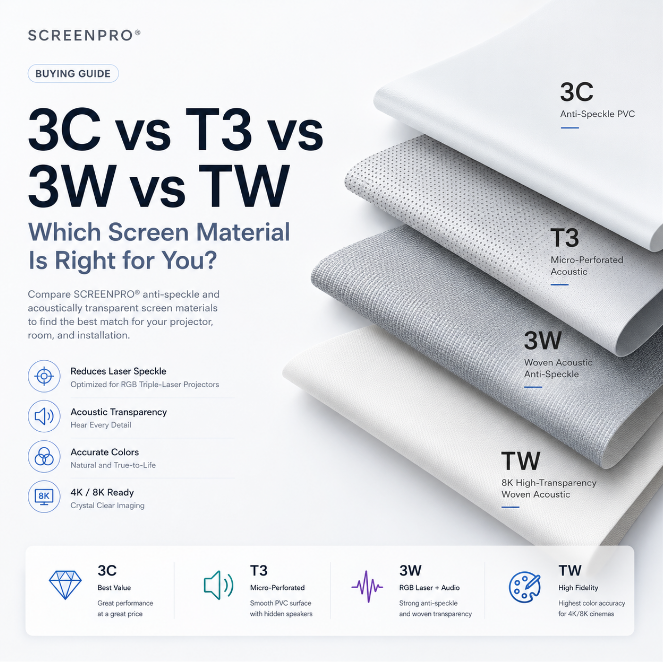
3C vs T3 vs 3W vs TW:
Which Screen Material Is Right for You?
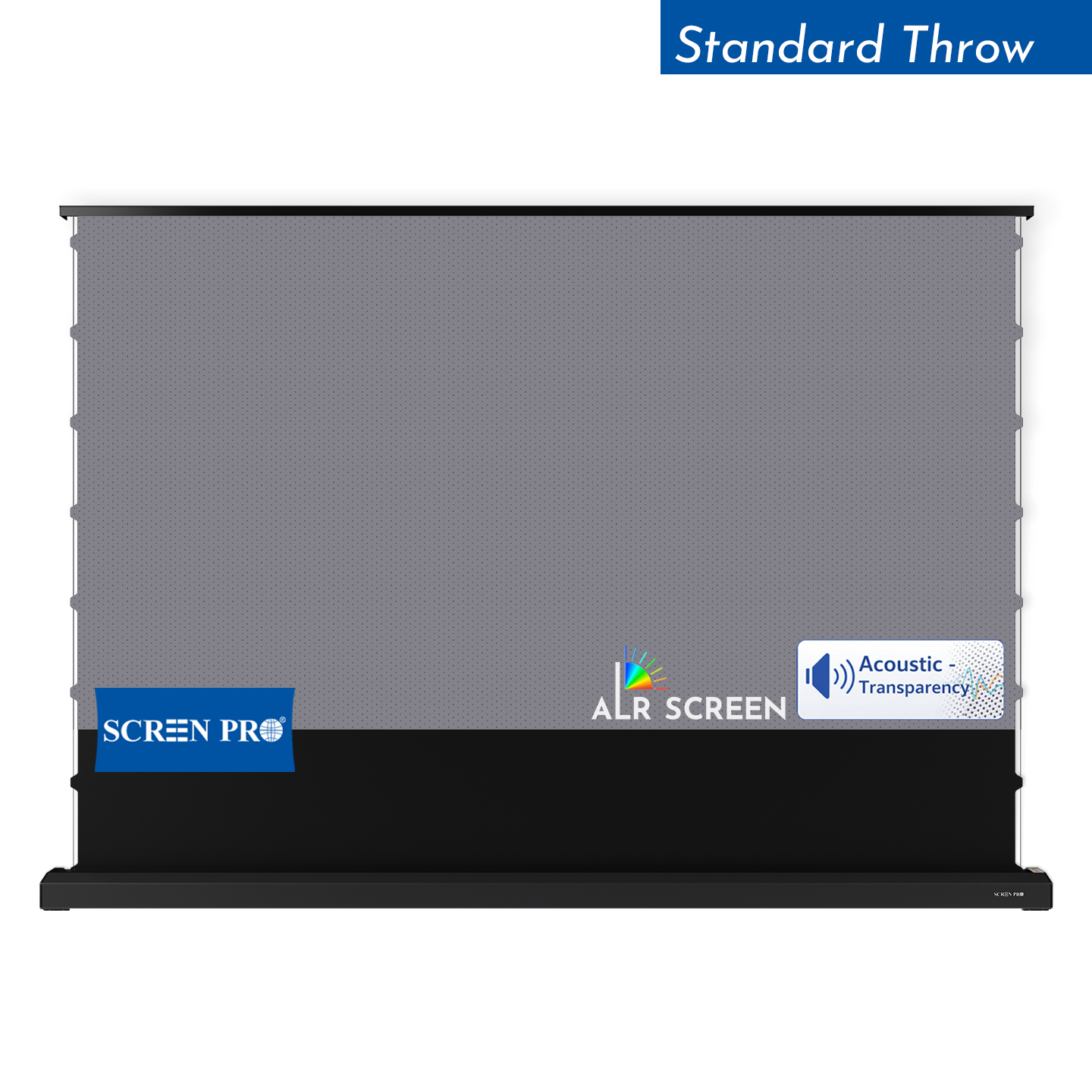
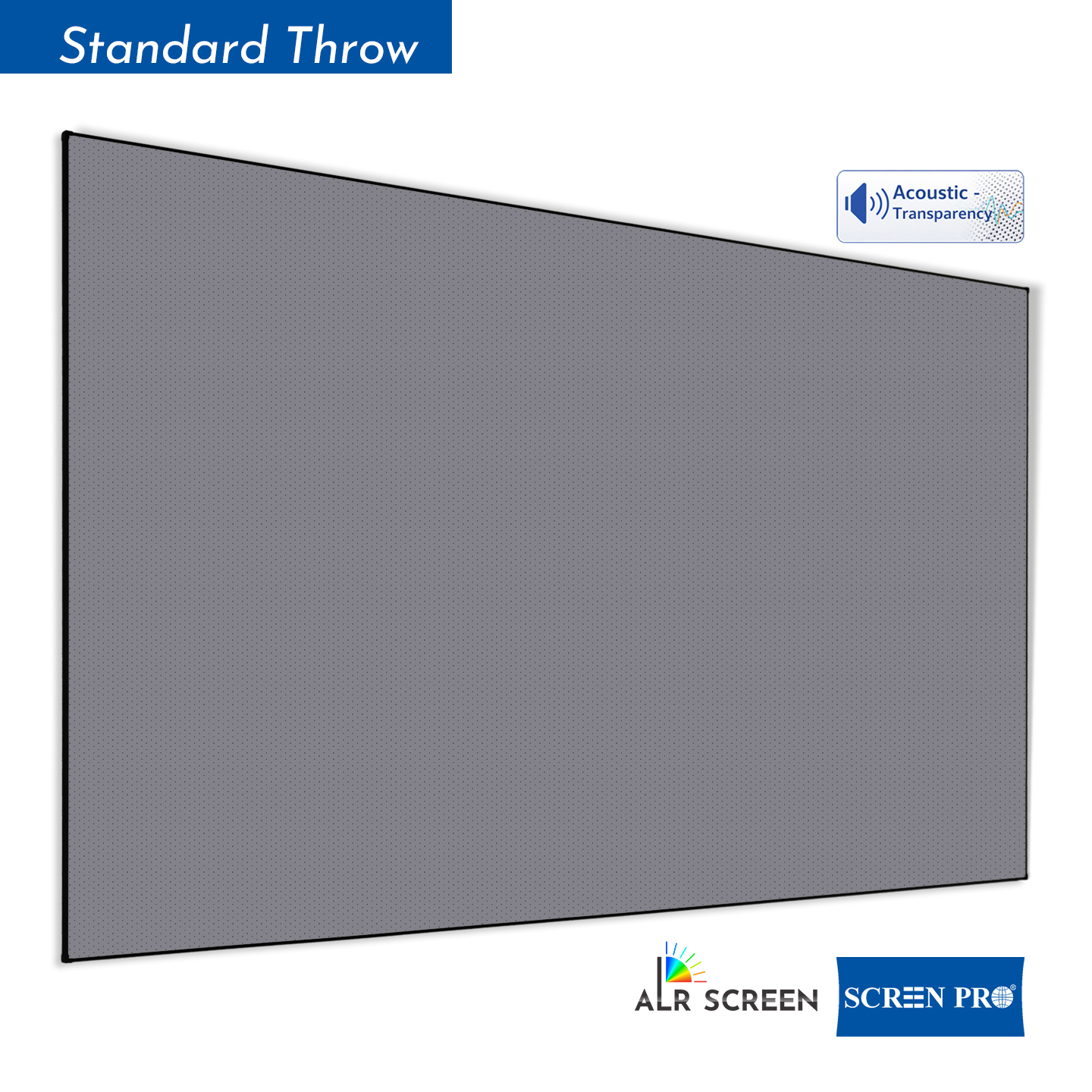
Compare SCREENPRO® anti-speckle and acoustically transparent screen materials to find the best match for your projector, room lighting, audio system, and viewing priorities.
Why laser speckle matters
RGB triple-laser projectors can produce exceptionally wide color, high brightness, and vivid images. However, their highly coherent laser light can also create visible granular patterns known as laser speckle.
Laser speckle may appear as a fine shimmering, sparkling, or grain-like texture over bright and solid-color areas of the projected image. Its visibility depends on the projector, screen surface, viewing distance, image content, and the sensitivity of the viewer.
A purpose-designed anti-speckle screen material helps diffuse and redistribute coherent laser light while preserving image detail, contrast, and color performance. This is why screen material selection is especially important when using an RGB triple-laser projector.
Anti-speckle performance is part of a complete system
The final result is influenced by the projector's optical design, screen material, screen size, viewing distance, room lighting, image mode, and individual sensitivity to speckle.
SCREENPRO® screen material specifications
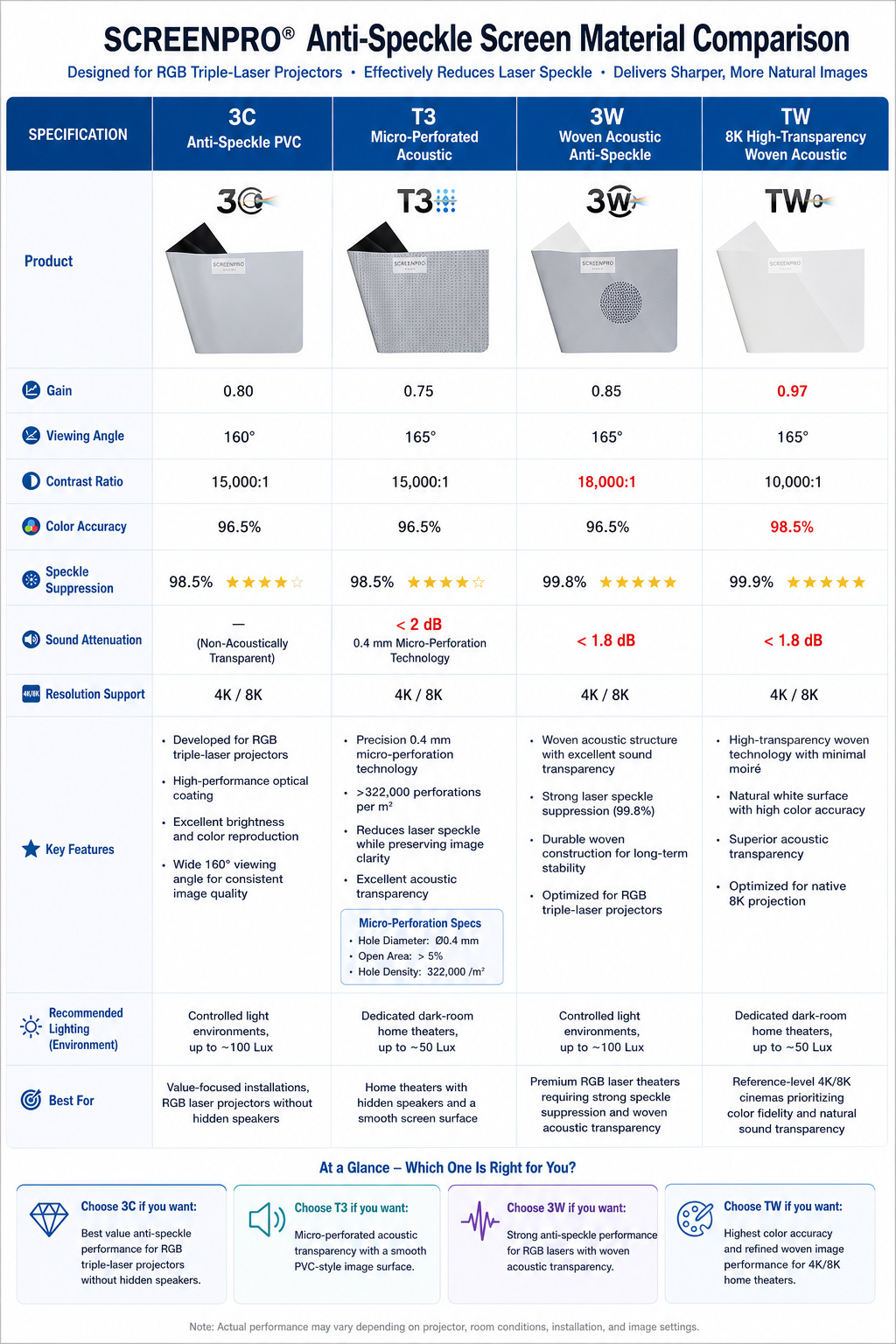
The four materials serve different priorities. Some focus on maximum anti-speckle performance, while others prioritize acoustic transparency, color fidelity, or overall value.
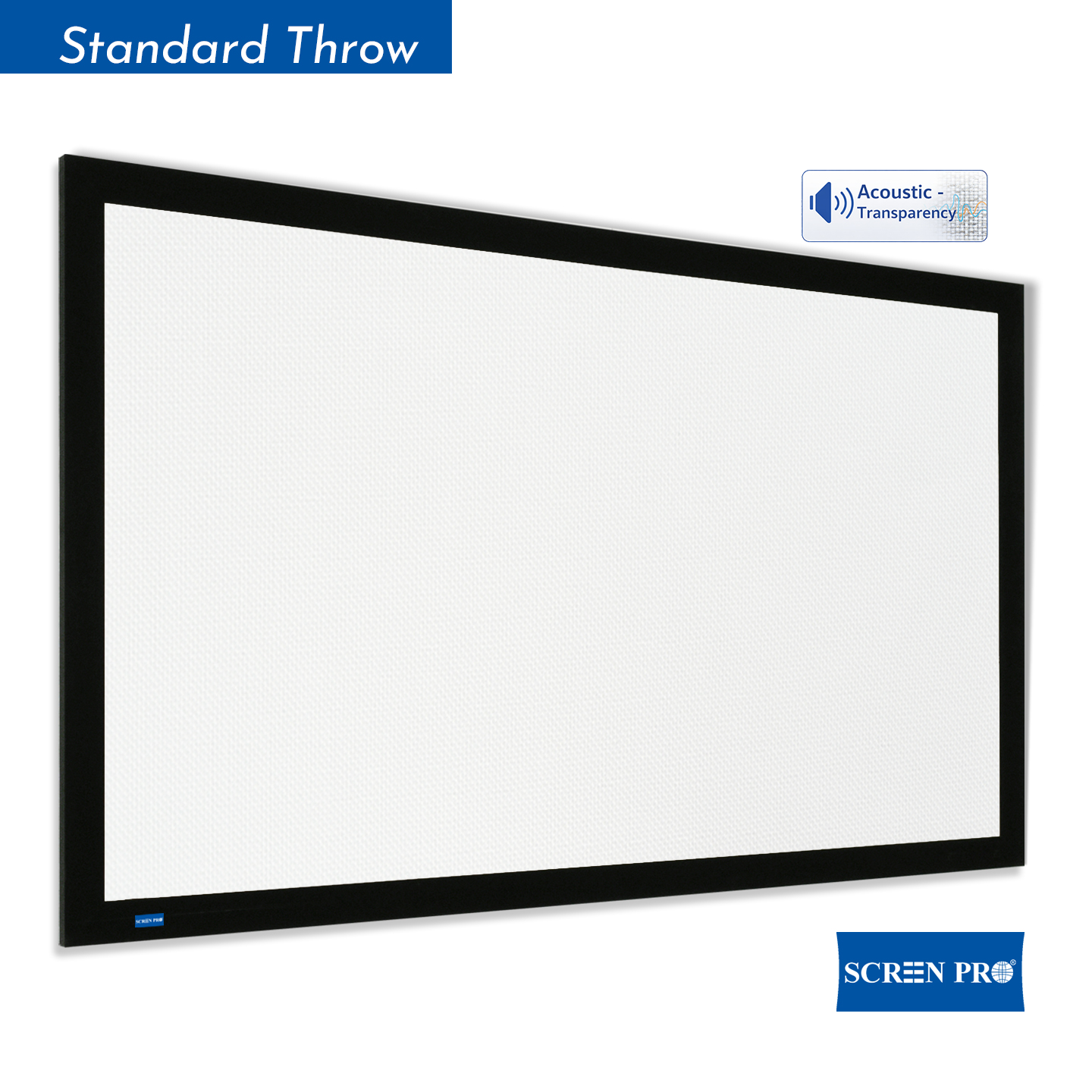
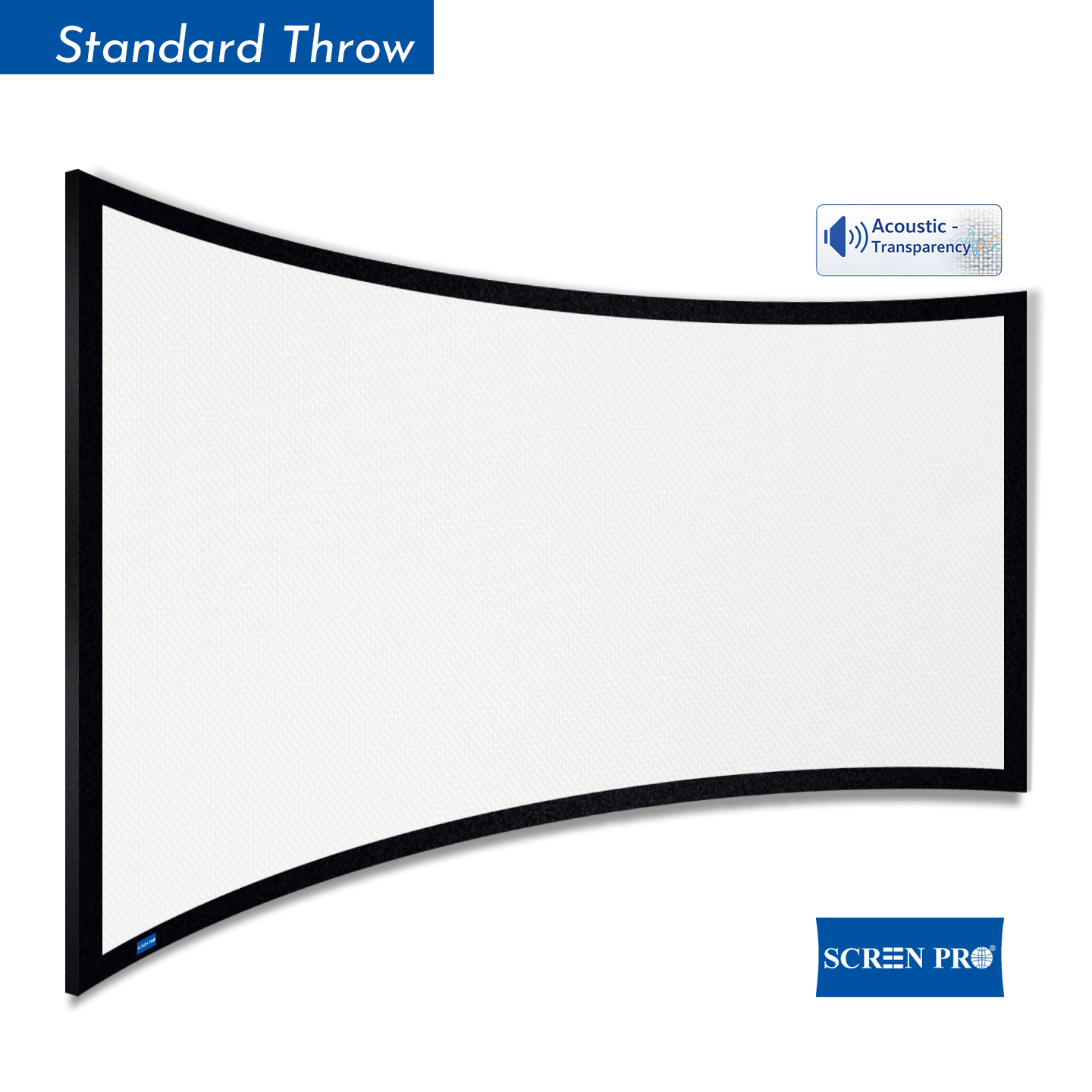
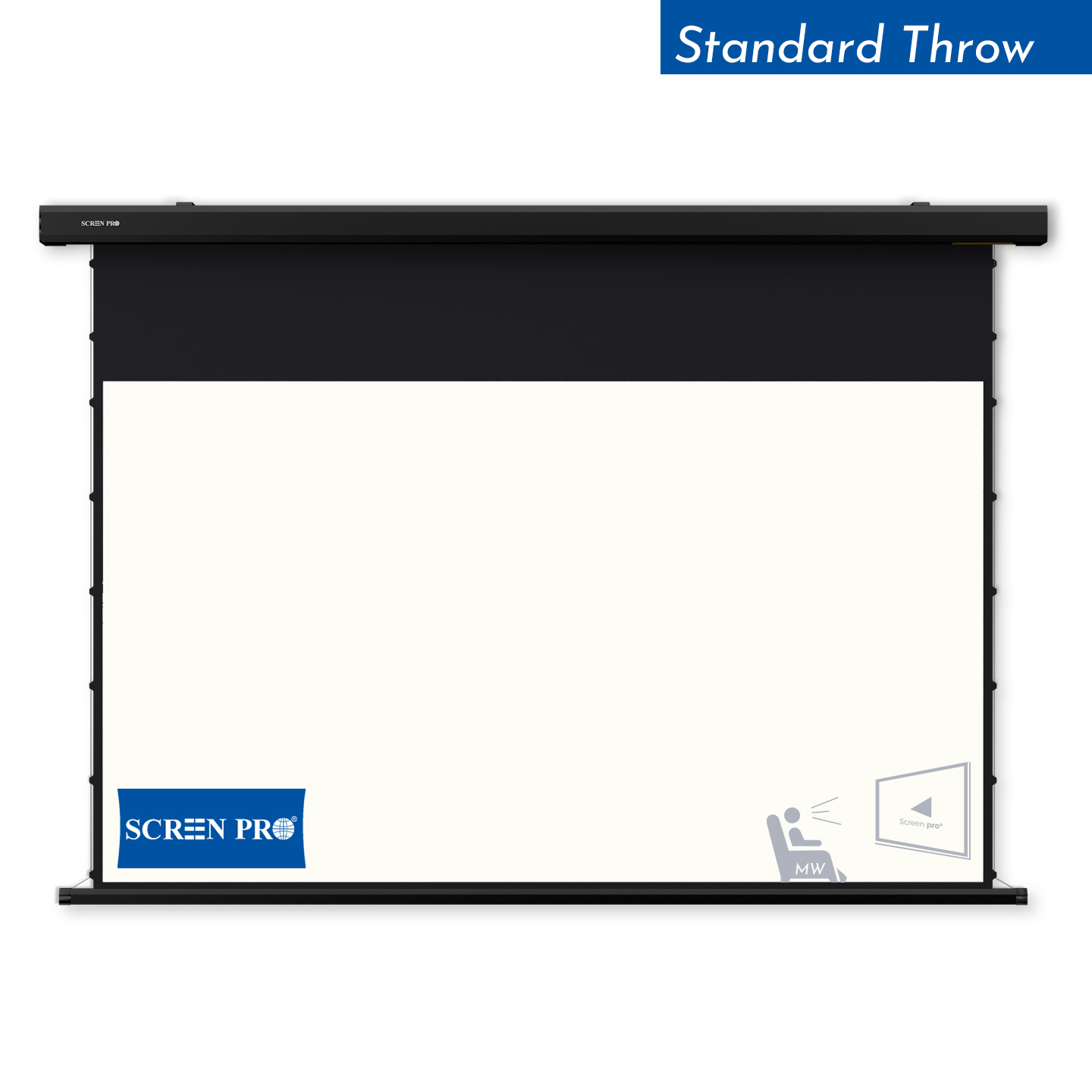
| Specification | 3C Anti-Speckle PVC | T3 Micro-Perforated Acoustic | 3W Woven Acoustic Anti-Speckle | TW 8K Woven Acoustic |
|---|---|---|---|---|
| Gain | 0.80 | 0.75 | 0.85 | 0.97 |
| Viewing Angle | 160° | 165° | 165° | 165° |
| Contrast Ratio | 15,000:1 | 15,000:1 | 18,000:1 | 10,000:1 |
| Color Accuracy | 96.5% | 96.5% | 96.5% | 98.5% |
| Speckle Suppression | 98.5% ★★★★☆ | 98.5% ★★★★☆ | 99.8% ★★★★★ | 99.9% ★★★★★ |
| Sound Attenuation | Not acoustically transparent | <2 dB 0.4 mm precision micro-perforation | <1.8 dB | <1.8 dB |
| Resolution Support | 4K / 8K | 4K / 8K | 4K / 8K | 4K / 8K |
| Primary Strength | Value-focused RGB laser anti-speckle performance | Micro-perforated acoustic transparency | Woven acoustic transparency and strong speckle suppression | High color accuracy and refined woven image performance |
| Recommended Lighting | Controlled light, up to approximately 100 lux | Dark-room cinema, up to approximately 50 lux | Controlled light, up to approximately 100 lux | Dedicated dark-room cinema, up to approximately 50 lux |
Understanding the differences
The best material is not automatically the one with the highest number. It is the material that fits your projector, speaker placement, installation type, and room conditions.
3C Anti-Speckle PVC
A solid anti-speckle PVC material developed for RGB triple-laser projection. It is designed to deliver strong overall image performance at an accessible price.
- Developed for RGB triple-laser projectors.
- Solid PVC surface without acoustic transparency.
- Balanced brightness, contrast, and color performance.
- Suitable for fixed-frame and tensioned screen systems.
- Ideal for users who do not place speakers behind the screen.
Value-focused home theaters, media rooms, gaming, and RGB laser installations with front, side, or below-screen speakers.
T3 Micro-Perforated Acoustic
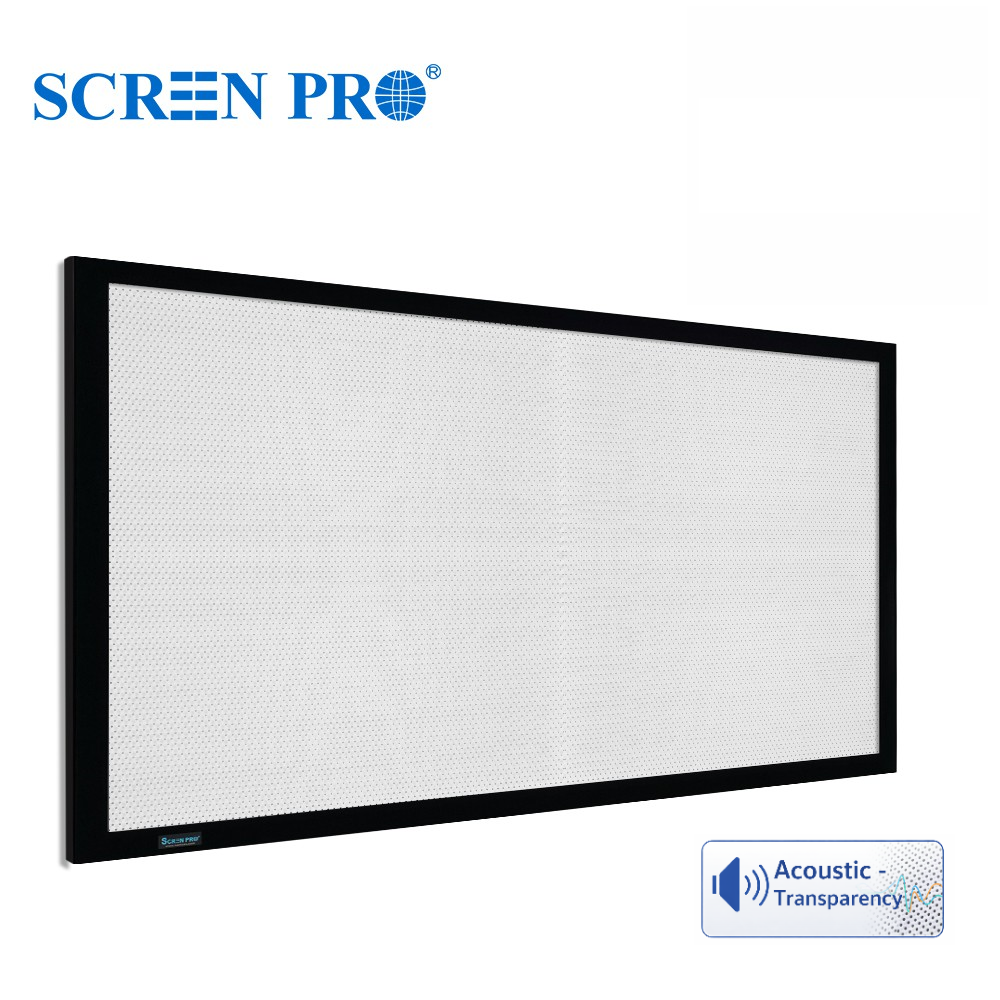
T3 uses precision micro-perforations to allow sound to pass through the screen while maintaining a smooth projection surface and anti-speckle performance.
- Precision 0.4 mm micro-perforation technology.
- More than 322,000 perforations per square meter.
- Supports center-channel and front-speaker placement behind the screen.
- Designed for controlled-light or dark-room environments.
- Provides a traditional smooth-surface projection appearance.
Dedicated home theaters requiring speaker placement behind the image and a micro-perforated screen structure.
3W Woven Acoustic Anti-Speckle
3W combines a woven acoustically transparent structure with an optical anti-speckle treatment, making it a strong choice for high-performance RGB triple-laser theaters.
- Woven acoustic structure for hidden-speaker installations.
- Developed for RGB triple-laser standard-throw projection.
- Strong laser speckle suppression.
- Wide viewing angle for multi-seat theater rooms.
- Compatible with a separate acoustically transparent black backing.
Premium RGB laser theaters that require both effective speckle suppression and acoustically transparent speaker placement.
TW 8K Woven Acoustic
TW is designed for high-resolution, acoustically transparent home cinema applications where natural color reproduction and refined image detail are the main priorities.
- Fine woven construction designed for 4K and 8K imaging.
- Natural white surface with high color accuracy.
- Acoustically transparent for concealed front speakers.
- Designed to minimize visible weave and moiré.
- Best used in carefully controlled dark-room environments.
Dedicated home theaters that prioritize image fidelity, high-resolution content, and natural sound transparency.
Which screen material should you choose?
Start with your projector type and speaker placement. Then consider room lighting, screen size, seating distance, and your image priorities.
Best when you need an RGB laser anti-speckle screen without acoustically transparent speaker placement.
Best when you want a smooth PVC-style image surface with speakers positioned behind the screen.
Best when RGB laser speckle suppression and woven acoustic transparency are both essential.
Best when natural color, detailed 4K or 8K imaging, and acoustic transparency are the main priorities.
A simple three-step selection method
Choose T3, 3W, or TW. Choose 3C when acoustic transparency is not required.
Give priority to 3C, T3, or 3W when laser speckle suppression is a major concern.
Select 3C for value, T3 for micro-perforated audio, 3W for RGB laser acoustic performance, or TW for image fidelity.
Choose by installation scenario
Room design and installation requirements often make the final decision clearer than specifications alone.
RGB laser media room
The speakers are outside the screen area, and the main goal is reducing laser speckle without significantly increasing the budget.
Recommended: 3CDedicated cinema with hidden speakers
The center and front speakers are installed behind the image, and a micro-perforated screen surface is preferred.
Recommended: T3Premium RGB laser theater
Strong anti-speckle performance and woven acoustic transparency are both required for a high-end installation.
Recommended: 3WReference-level 4K or 8K cinema
The room is carefully light-controlled, and natural color, image texture, and sound transparency are the priorities.
Recommended: TWMulti-row home theater
A wide viewing angle is needed to maintain consistent brightness and color across multiple seating positions.
Consider: T3 / 3W / TWLiving room projection
The room has some controlled ambient light, but it is not a fully dark dedicated theater.
Consider: 3C / 3WAnti-speckle performance and ambient-light rejection are different functions. For bright rooms or daylight viewing, choose a screen material specifically designed for ambient-light rejection and make sure it is compatible with your projector's throw type.
Four factors that affect the final result
1. Projector light source
RGB triple-laser projectors are more likely to make laser speckle visible than lamp, LED, or some hybrid laser projectors. Confirm your projector's light-source technology before choosing an anti-speckle material.
2. Speaker placement
Choose an acoustically transparent material only when speakers will be installed behind the screen. If all speakers are outside the image area, a solid material such as 3C may provide a simpler and more cost-effective solution.
3. Room lighting
These materials perform best in controlled-light environments. Darker rooms generally improve perceived contrast, black level, color saturation, and image depth.
4. Viewing distance
Screen texture, weave, and perforation visibility depend on screen size and seating distance. For large screens or close seating positions, request a material sample before finalizing the installation.
Anti-speckle screen material FAQ
Answers to common questions about 3C, T3, 3W, and TW screen materials.
3C, T3, and 3W are specifically positioned for RGB triple-laser projection. Choose 3C when acoustic transparency is not required, T3 when you prefer a micro-perforated acoustic surface, and 3W when you need a woven acoustically transparent anti-speckle material.
Not in every installation. 3W is more suitable when speakers are installed behind the screen and stronger woven acoustic performance is required. 3C is generally the more economical and straightforward choice when acoustic transparency is unnecessary.
T3 uses precision micro-perforations in the screen surface, while 3W uses a woven acoustic structure. T3 offers a smooth micro-perforated appearance, whereas 3W provides woven acoustic transparency and is designed for strong RGB laser speckle suppression.
Based on the comparison specifications, TW provides the highest stated color accuracy at 98.5%. It is intended for dark-room home theaters where natural color reproduction and high-resolution image fidelity are primary priorities.
No. 3C is a solid PVC screen material and is not acoustically transparent. For speakers positioned behind the screen, choose T3, 3W, or TW.
Any material placed in front of a speaker can affect sound to some degree. However, purpose-designed acoustically transparent screen materials minimize this effect. Proper speaker positioning, equalization, and room calibration can further optimize the result.
TW may reduce the visibility of speckle due to its woven surface, but its primary design priority is high image fidelity and acoustic transparency. For an RGB triple-laser installation where speckle control is the main concern, 3C, T3, or 3W should be considered first.
Yes. A sample allows you to evaluate brightness, color, surface texture, speckle visibility, viewing angle, and projector compatibility in your own room before purchasing a complete screen.
They are primarily intended for controlled-light home theater environments. Anti-speckle materials should not automatically be treated as ambient-light-rejecting screens. Bright-room installations require a compatible ALR material selected according to projector throw type.
Not sure which material fits your projector?
Tell us your projector model, screen size, room lighting, installation type, speaker position, and destination country. A SCREENPRO® specialist will help you compare suitable options.